IAM Union · District 141
Fleet Service
2026 Tentative Agreement — a plain-language summary of the proposed changes.
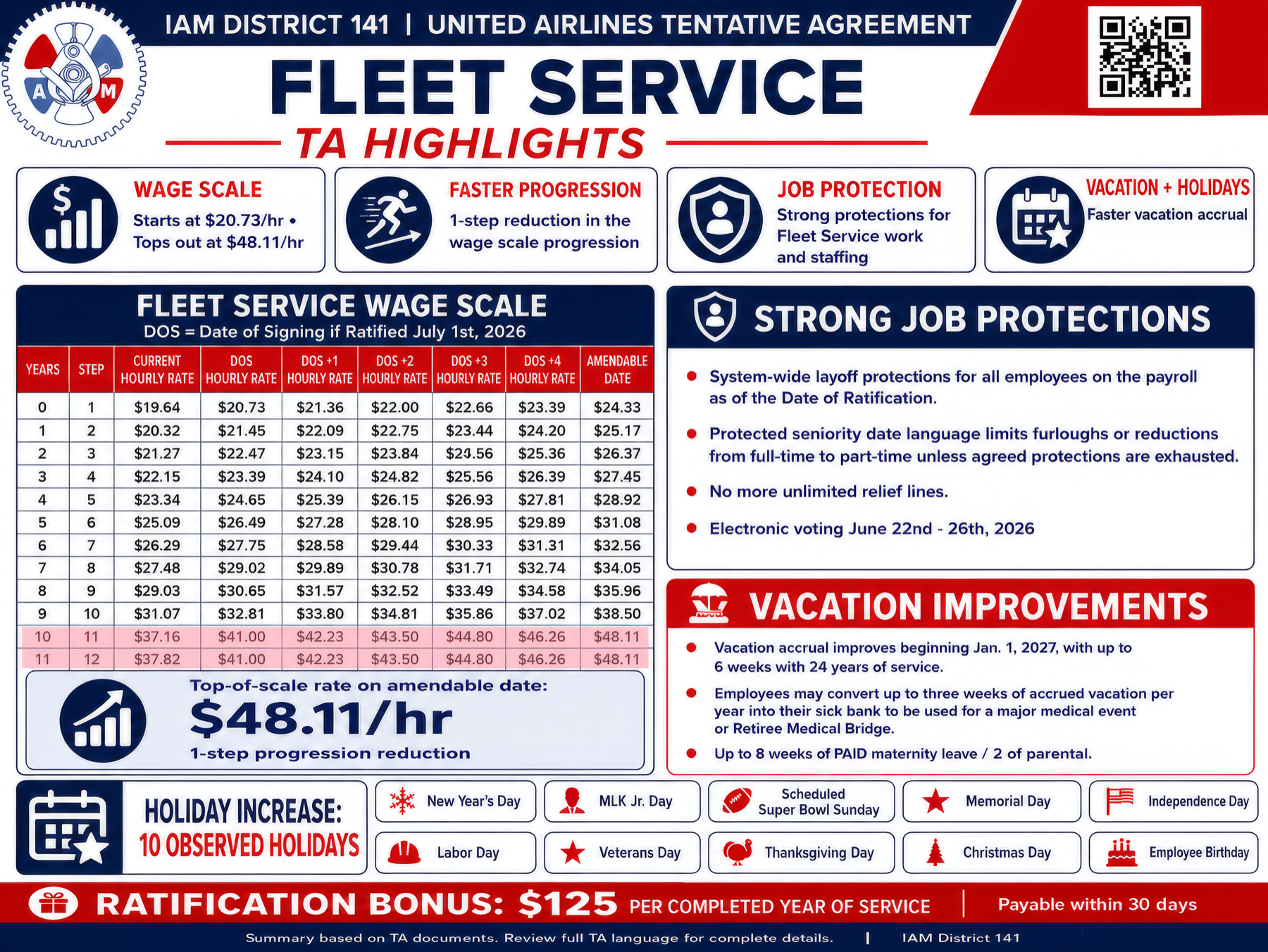
| Years | Step | Current | DOS | DOS +1 | DOS +2 | DOS +3 | DOS +4 | Amendable Date |
|---|---|---|---|---|---|---|---|---|
| 0 | 1 | $19.64 | $20.73 | $21.36 | $22.00 | $22.66 | $23.39 | $24.33 |
| 1 | 2 | $20.32 | $21.45 | $22.09 | $22.75 | $23.44 | $24.20 | $25.17 |
| 2 | 3 | $21.27 | $22.47 | $23.15 | $23.84 | $24.56 | $25.36 | $26.37 |
| 3 | 4 | $22.15 | $23.39 | $24.10 | $24.82 | $25.56 | $26.39 | $27.45 |
| 4 | 5 | $23.34 | $24.65 | $25.39 | $26.15 | $26.93 | $27.81 | $28.92 |
| 5 | 6 | $25.09 | $26.49 | $27.28 | $28.10 | $28.95 | $29.89 | $31.08 |
| 6 | 7 | $26.29 | $27.75 | $28.58 | $29.44 | $30.33 | $31.31 | $32.56 |
| 7 | 8 | $27.48 | $29.02 | $29.89 | $30.78 | $31.71 | $32.74 | $34.05 |
| 8 | 9 | $29.03 | $30.65 | $31.57 | $32.52 | $33.49 | $34.58 | $35.96 |
| 9 | 10 | $31.07 | $32.81 | $33.80 | $34.81 | $35.86 | $37.02 | $38.50 |
| 10 | 11 | $37.16 | $41.00 | $42.23 | $43.50 | $44.80 | $46.26 | $48.11 |
| 11 | 12 | $37.82 | $41.00 | $42.23 | $43.50 | $44.80 | $46.26 | $48.11 |
These are base wage rates only. They do not include premium pay, lead pay, overtime, shift differentials, license pay, or any other additional compensation that may apply.
The Years column shows how many completed years of seniority an employee has. The Step column shows the pay step tied to that seniority level.
The final two rows show the same negotiated rates. That is important because this agreement would eliminate the final pay step in the progression.
DOS means Date of Signing. DOS +1 means one year after Date of Signing, DOS +2 means two years after Date of Signing, and so on.
Amendable Date means the point when the contract would be open for future negotiations.
The agreement includes a ratification payment for eligible employees after contract ratification.
Eligible employees would receive $125.00 for each completed year of Company service as of the date the agreement is signed.
Employees with less than one year of service would receive a minimum payment of $125.00.
The payment will be issued within 30 days after signing the ratified agreements.
The LOA lists several employee statuses that remain eligible for the ratification payment on the signing date of the agreement.
- Active employees
- Leaves of absence
- Illness
- Military leave
- Certain personal and educational leaves provided under the agreement
No employee in active service, or on an approved leave of absence, on the date of signing of this Agreement with a Company seniority date of July 1, 2026 or earlier would be furloughed from employment with the Company, or furloughed from full-time status to part-time status, unless the Company first provides that employee an opportunity to exercise seniority on the system.
Before a protected employee could be furloughed or reduced to part-time status, the employee would have to be given the opportunity to:
- Fill a permanent full-time vacancy somewhere on the system;
- Displace a junior employee not protected by this language from a permanent full-time position;
- Displace a junior employee in either full-time or part-time status not protected by this language; or
- Fill a permanent vacancy in a higher classification the employee is qualified to hold.
If an employee fails to exercise seniority, declines available opportunities, or does not have sufficient seniority to hold a protected position, the employee could still be furloughed or reduced to part-time status.
Employees furloughed under these circumstances would remain eligible for applicable recall rights and normal furlough pay.
The agreement increases hourly per diem rates for Fleet Service employees traveling on Company business.
Beginning July 1, 2026, the domestic per diem rate would increase to $2.30 per hour, and the international per diem rate would increase to $2.80 per hour.
The rates would continue increasing by $0.05 per hour each year through January 1, 2031.
| Effective Date | Domestic Per Diem | International Per Diem |
|---|---|---|
| July 1, 2026 | $2.30/hr | $2.80/hr |
| January 1, 2027 | $2.35/hr | $2.85/hr |
| January 1, 2028 | $2.40/hr | $2.90/hr |
| January 1, 2029 | $2.45/hr | $2.95/hr |
| January 1, 2030 | $2.50/hr | $3.00/hr |
| January 1, 2031 | $2.55/hr | $3.05/hr |
The agreement adds Martin Luther King, Jr. Day, Scheduled Super Bowl Sunday, Veterans Day, and the employee’s birthday to the observed holiday list.
| Month | Observed Holiday |
|---|---|
| January |
New Year’s Day Martin Luther King, Jr. DayNew |
| February | Scheduled Super Bowl SundayNew |
| May | Memorial Day |
| July | Independence Day |
| September | Labor Day |
| November |
Veterans DayNew Thanksgiving Day |
| December | Christmas Day |
| Birthday | Employee’s BirthdayNew |
If an employee’s birthday falls on an observed holiday, the birthday holiday would move to the following calendar day.
During the general block vacation bid, employees may elect to be off on their birthday.
Trades picked up on a co-worker’s birthday would be paid at straight time.
The new vacation accrual schedule would begin January 1, 2027, for vacation use starting January 1, 2028.
The TA moves several vacation milestones forward, shortening the wait for additional vacation weeks.
This agreement would create paid leave following the birth or adoption of a child.
Birth Parents would be eligible for up to eight calendar weeks of Paid Maternity Leave for medical recovery following delivery.
Eligible new parents would also be able to take up to two calendar weeks of paid New Parent Leave following the birth or adoption of a new minor child. This includes time for baby bonding.
The agreement recognizes both Birth Parents and non-Birth Parents.
These benefits would coordinate with federal, state, and local leave programs so employees can receive up to 100% of regular pay.
The agreement updates 401(k) matching contribution language for employees covered by the Fleet Service agreement.
Matching contributions would equal the greater of 100% of employee before-tax contributions up to $300 per plan year, or the applicable service-based match.
Effective January 1, 2028, eligible employees would receive a direct Company contribution equal to 1% of eligible earnings under the 401(k) plan.
Effective on the amendable date of the agreement, that direct contribution would increase to 2%.
If the IAM National Pension Plan rehabilitation plan increases, the Company may reduce all or part of the scheduled direct contribution to cover all or part of the additional rehabilitation-plan cost.
Before any reduction applies, the Company and Union must meet and discuss how the reduction would apply. Once implemented, the direct contributions described in the agreement cannot be reduced.
The agreement creates contractual meal-period placement rules for shifts under 8 hours that qualify for a meal period.
Under the new language, meal periods for those shifts should be scheduled between two hours before and two hours after the midpoint of the shift.
In situations where a meal period is placed within the first 30 minutes of the shift, and with management pre-authorization, employees may:
- Accept the meal period
- Accept the meal period and leave 30 minutes early
- Forego the meal period
- Forego the meal period and leave 30 minutes early
Employees will be paid for all hours worked.
| Shift | Shift Length | Meal Period Window |
|---|---|---|
| 0600-1130 | 5.5 hours | 0645-1045 |
| 0600-1200 | 6.0 hours | 0700-1100 |
| 0600-1230 | 6.5 hours | 0715-1115 |
| 0600-1430 | 8.5 hours | 0900-1200 |
| 0600-1630 | 10.5 hours | 1000-1300 |
Employees may convert up to 3 weeks of accrued vacation per year into their sick bank, up to the maximum sick bank accrual, for the purpose of funding sick pay for a planned upcoming significant medical event (e.g., maternity or major surgery or course of treatment, which will be documented, or Retiree Bridge Medical).
The agreement would place a contractual limit on Relief bid lines at each station. The Company would no longer be able to make everyone Relief.
Relief bid lines, in any combination, will not exceed 30%.
The TA also makes clear that no station is required to use 30% Relief lines.
The agreement strengthens the definitions of the two types of Relief schedules.
OR-A (To cover day-to-day outages) employees would bid consistent start times, end times, and Regular Days Off for the duration of the general shift bid.
OR-B (To cover longer-term outages) lines could be adjusted based on operational needs and rebid as often as every 30 days.
OR-B schedules will be reviewed with Local management and the Local Committee before posting.
The agreement would begin the process of creating automated wishlist technology for Relief employees.
It is anticipated that this technology will become functional in Q1 2027.
Once developed, non-probationary employees bidding Relief lines would be able to submit preferences for qualified work areas during the general shift bid process.
Examples listed in the TA include Gate, Lobby, Planeside, and Bag Room assignments.
This would give Relief employees a clearer way to identify the work areas where they would prefer to be assigned.
Once assigned to a work area at the start of a shift, Relief employees would become part of that work area for the shift.
If movement of work becomes necessary, the Company would apply the contractual movement-of-work rules under Article 4.B.1.
Employees working overtime or trades would not be able to use seniority to displace employees already working their Relief assignments.
Employees under investigation now have the explicit right to choose their Union representative if reasonably available and on duty.
A second Union representative may now participate strictly as a notetaker in certain investigations.
The Company may limit representation to one representative per side in sensitive investigations involving harassment, discrimination, privacy, or similar concerns.
Witnesses to investigations now have the explicit right to request Union representation or Union advice before making statements.
The Company must now provide copies of statements to the Union representative present during questioning.
Union representatives must be given a reasonable opportunity to consult privately with the employee before questioning begins.
If a statement is taken without Union representation present, the Company must provide a copy to the Union upon written request.
Employees and the Local Committee must now receive written notification regarding the outcome of investigations.
Awarded trades and overtime must now be paid for up to fourteen (14) calendar days while held out pending investigation.
At each station, the Company and Union must now establish a formal process for scheduling and conducting Investigative Review Meetings (IRMs).
IRMs are intended to be held within fifteen (15) business days following proposed charges.
Company evidence must be provided at least 96 hours before the IRM, while Union evidence must be provided at least 48 hours before the IRM.
The Company will issue IRM decisions within thirty (30) calendar days.
Lead and Move Team employees currently receive a premium of $3.00 per hour in addition to their basic hourly pay rate.
Effective January 1, 2029, the Lead and Move Team Premium will increase to $3.25 per hour.
The new language would require the company to better communicate the mandatory overtime assignment to include reason, seniority and estimated duration of mandatory assignment.
The TA also updates how assignments may be grouped. Shift end times within 45 minutes of the start of a mandatory overtime assignment may be grouped together, as established by Local Committees and Management.
The agreement would prevent the Company from unilaterally imposing a vaccination requirement on employees covered by the contract.
Vaccination requirements could still apply if they are required by law or connected to the terms of a government contract.
Voluntary vaccination incentive programs would still be allowed.
The old language required a rebid when a permanent schedule change was exactly 1 hour or more.
The new language changes that standard to more than 1 hour.
The agreement allows the Company to create temporary assignments of less than 90 days within the same classification.
Assignments that reach 90 days or more must be posted as regular vacancies.
The Company must notify the Union as soon as practical when short duration assignments exceed 30 days.
Temporary Duty Assignments, or TDYs, are used when employees are needed outside their home location to supplement staffing.
If a TDY is expected to exceed 90 days, the Company must confer with the Local Committee.
If a TDY is expected to exceed 120 days, the Company must confer with the PDGC or designee.
Each station would establish a yearly TDY pool to help fill TDY assignments more quickly.
Employees may opt in or opt out of the pool at times designated by the Company. Employees joining after January 1 would be placed at the bottom of the TDY list.
The first TDY assignment of the year would be offered by basic bid seniority. After an employee accepts or declines a TDY assignment, that employee would move to the bottom of the list.
If the Company does not follow the assignment order, the affected employee will receive first right of refusal for the next qualified TDY opportunity, as long as the employee notifies the Company within 72 hours.
Seasonal assignments would generally be limited to less than 120 days per rolling calendar year, with additional days requiring agreement of the Local Committee.
Project assignments would be used for specialized work outside normal duties, posted and awarded based on qualifications and an interview.
Per LOA 09 in the 2023-2025 Agreement, protections covering non-core work would otherwise expire on December 31, 2026.
Under this LOA, if non-core work is transferred to another United work group, the Company must provide advance notice to the Union.
The agreement also states that through one month before the amendable date of the agreement, transferring non-core work to another United work group will not directly cause a reduction in force for employees at the location where the transfer occurs.
In addition, where deicing work is being performed by Ramp Service employees as of July 1, 2026, that work would remain protected and could not be contracted out during the life of the LOA.
The LOA would expire one month before the amendable date of the agreement.